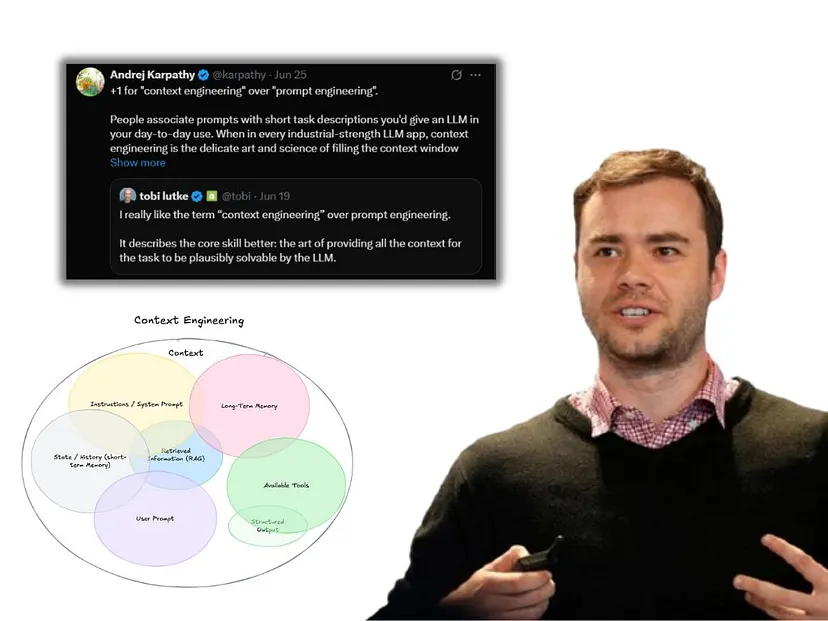
Wait — context what now? Another tech buzzword, or is this actually something real?
Just like that, the internet had a new phrase to obsess over. But this isn't just a vibe. It's a new way of prompting.
Even Shopify's CEO weighed in:
I really like the term 'context engineering' over prompt engineering. It describes the core skill better: the art of providing all the context for the task to be plausibly solvable by the LLM.
And now everyone's asking the same question: is this what separates average prompts from jaw-dropping AI outputs?
Before we get to that, you need to understand what GenAI actually is. Once you do, the whole concept of context engineering hits very differently.
We throw around the word GenAI like it's some big, futuristic invention. But it's already sitting behind our daily habits — whether it's the Meta feature that changes your t-shirt into a black tank top, or Spotify's perfectly curated Chill Mix. It's everywhere.
So What Is Generative AI, Really?
First, let's understand what traditional AI was.
Say you're building a program to detect spam emails. You feed it thousands of examples — some spam, some not. The model learns the patterns. Then when a new email arrives, it says: "Spam" or "Not spam." This is predictive AI. It works really well for tasks like fraud detection and recommendation systems. It's accurate, but it doesn't create anything new.
Now comes generative AI. The word "generate" means to create something. So GenAI doesn't just analyse — it produces.
Say you want a blog post on "How to start a YouTube channel." You give it a prompt, and the AI generates the entire blog in natural language. Same with images: you write "show me a panda doing yoga in space," and it gives you that image. You don't need to design it pixel by pixel.
So what's the main difference?
Traditional AI: you give input, it predicts a label or a number.
GenAI: you give input, it creates text, images, audio, or even code.
Now here's the real deal that most people still ignore: it's not just about having access to GenAI. It's about how you talk to it.
Because at the heart of this whole thing — whether you're generating an email, a rap song, or a logo for your new startup — lies one thing: the prompt. That one line of instruction is what decides whether you get a "wow," a "meh," or a "what on earth is this?"
How Prompting Evolved into Context Engineering
A while ago, everyone was hyped about prompt engineering. Job descriptions started saying "must know how to write great prompts."
But there's a new kid on the block.
First, Let's Talk About Prompt Engineering
You give ChatGPT an instruction — "write me an email" — and it does it.
But we quickly realised that if you only give a one-line prompt, the results are average. Why? Because the model is just trying to guess what you want, with very little information.
This is where Andrej Karpathy, the OG AI guy (ex-Tesla, ex-OpenAI), made the point that the prompt is the program, and context is all you have.
Because GenAI doesn't "understand" the way humans do. It isn't thinking. It's predicting the next best word, based on what you've already told it.
Why Context Matters More Now
Back in 2022 when ChatGPT first dropped, it was trained on a massive chunk of the internet — blogs, Wikipedia, Reddit, StackOverflow.
But now it's being fine-tuned to behave more like us. It needs more clarity, more personalisation, more framing.
Just like you wouldn't ask a graphic designer, "make me a poster." You'd say: "Make me a poster for an Instagram giveaway. Target audience is 18–25, brand colours are blue and orange, tone should be playful but premium."
See the difference? That second one is context engineering.
Analogy: Context Is Like a Map
Say you get into a cab and tell the driver: "Take me to Sector 5."
But you didn't say which city, which route, or whether you want to avoid tolls or take the highway. So now the driver — the GenAI — is confused. He might still drive somewhere, but it might not be where you want to go.
Now compare that with: "Sector 5, Salt Lake, Kolkata. Fastest route. Avoid traffic."
Same driver, far more useful, just because you gave better context.
There's This Tiny Thing Called the Context Window
There's one small but important concept that trips up a lot of people: the context window.
Think of it as ChatGPT's short-term memory. It can only "see" and remember a limited number of tokens — words, punctuation, code — at a time.
GPT-4o has a context window of 128k tokens, roughly 300 pages of content. And once it's full? Just like a whiteboard, the oldest information gets erased to make space for the new. So if you're mid-conversation and refer to something you said much earlier, the model might simply have forgotten.
That's why structuring your prompt smartly matters. Give too much and it won't fit the window; give too little and you won't get the result you need.
Think of it like packing a small suitcase for a three-day trip. You don't throw everything in — you pick only what matters.
Where Do We Go From Here?
We've covered what GenAI is, how it works, what context engineering is, and how to prompt effectively.
So this was about how to talk to GenAI. The natural next step is how to build your own — how people are actually creating their own GenAI tools and agents.
If you've ever thought "can I build my own AI assistant?" — that's exactly where to go next.
This article was originally published on Medium by the My Equation team.