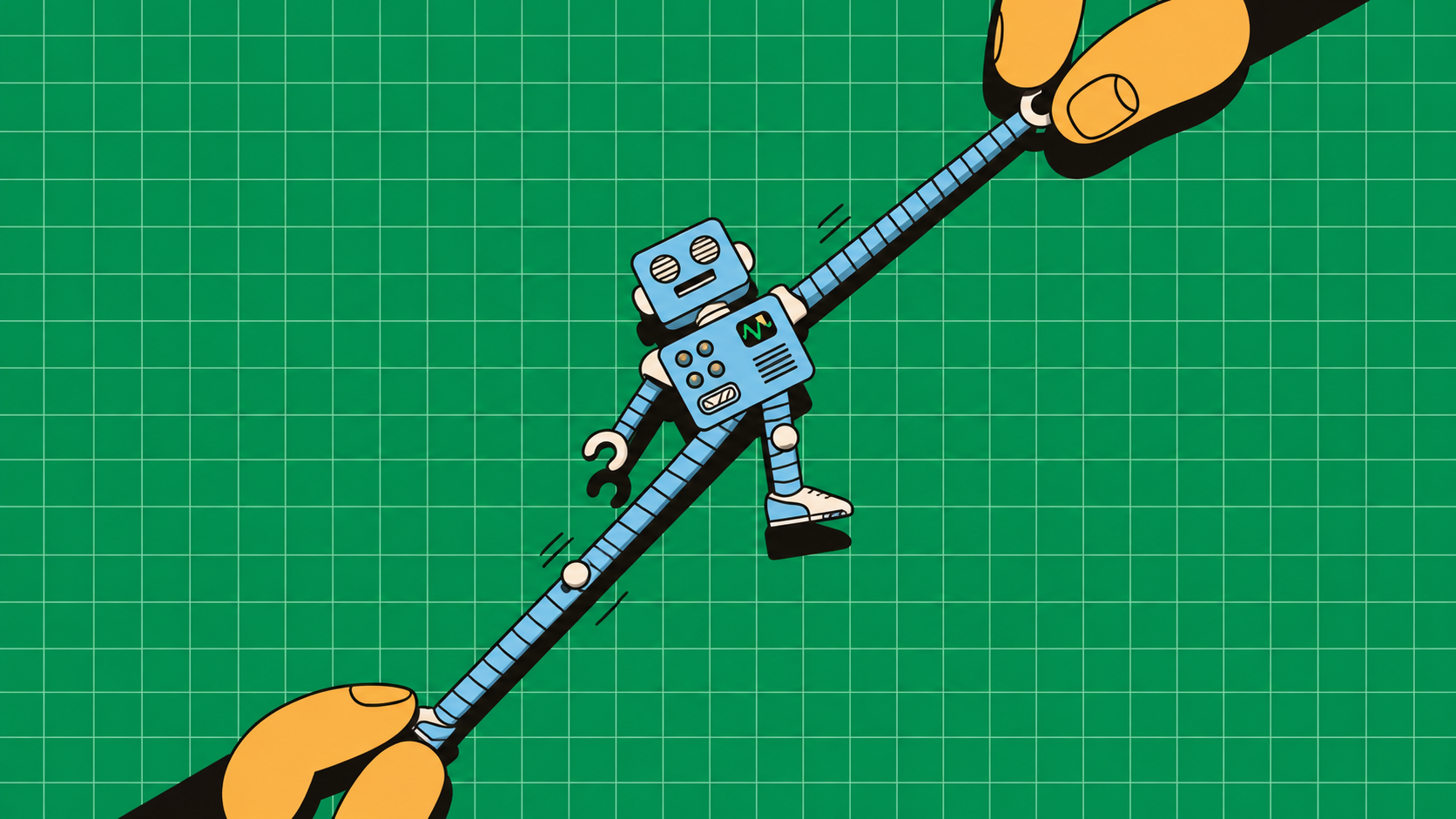
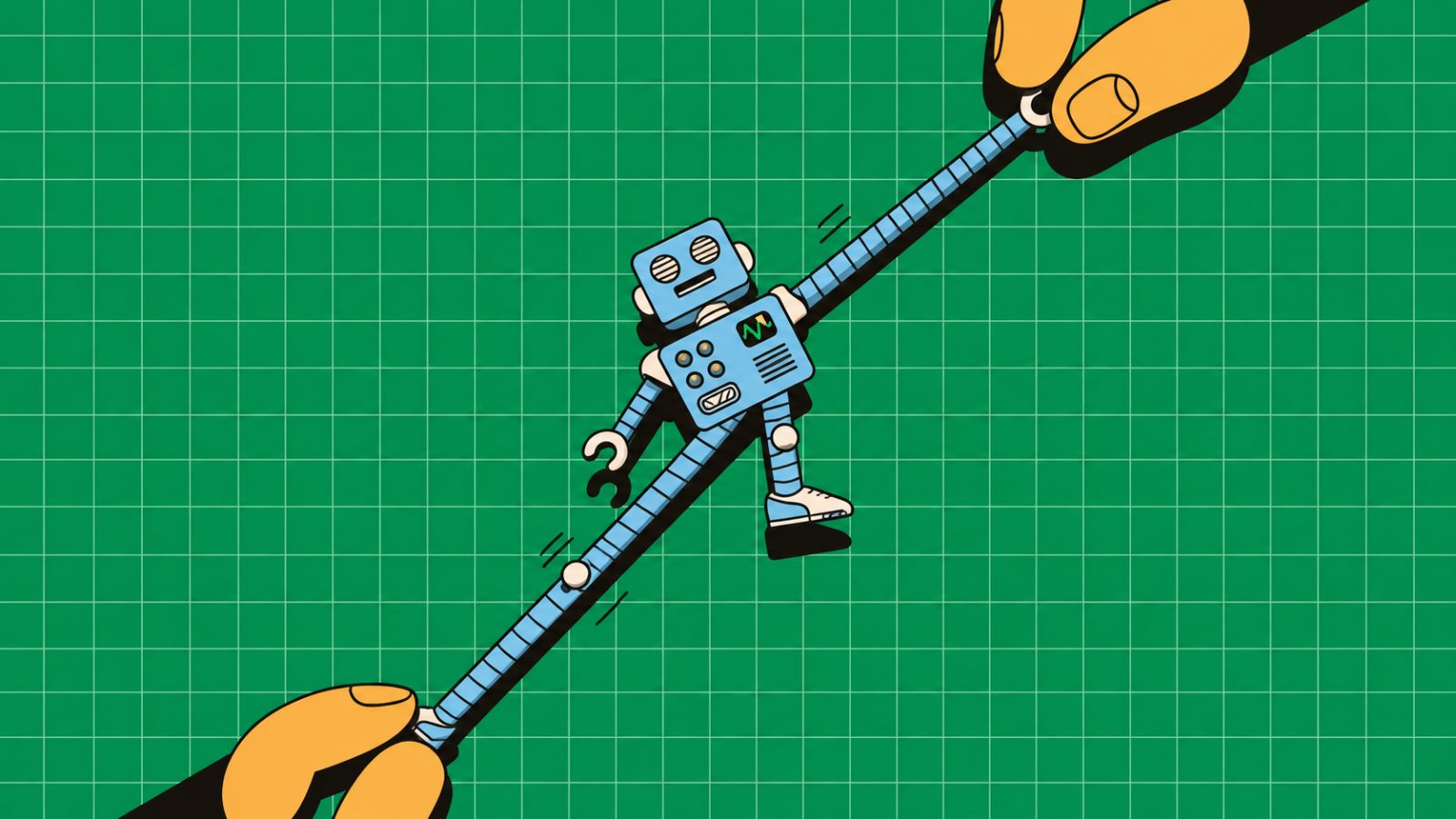
Nobody asks whether a washing machine understands the emotional significance of your favorite T-shirt. You press start and trust it with a garment you would be upset to lose.
A robot deserves the same practical consideration. If its job is to move a component from one station to another, doing that accurately a thousand times is already useful. Recognizing the component, handling unfamiliar objects, or responding to spoken instructions introduces a different set of challenges.
Somewhere in that conversation, we started treating artificial intelligence as a basic requirement for robotics. So what actually makes a robot work and when does AI earn its place? The answer starts with three ideas that often get bundled together: control, automation, and machine learning.
First, What Makes a Robot a Robot?
For this discussion, think of a robot as a programmable physical machine that performs actions using actuators, such as motors. Sensors often provide information about its own condition or the surrounding environment.
A mobile robot might use distance sensors to detect obstacles, encoders to measure wheel rotation, and motors to move. Its operation involves three broad functions: gathering information, processing it, and acting on the result. The processing does not automatically require AI. It might involve a mathematical controller, a sequence of instructions, or a simple rule: stop when an obstacle gets too close.
A robot can react to its surroundings without recognising objects or learning from experience. Sensing something and understanding what it is are different capabilities.
Control: Making the Wheels Cooperate

Let's start with the layer every robot needs. The classic example is a thermostat. It checks the temperature, compares it to your target, and turns the heater on or off. That is a feedback loop, and it is the beating heart of robotics. Swap the heater for a motor, and you have a robot joint that checks where it is, compares that to where it should be, and corrects the difference many times per second.
The workhorse here is something called a PID controller. You do not need the math to appreciate it. Think of it as a driver holding a steady speed on a highway: one part reacts to how far off you are, one part remembers how long you have been off, and one part anticipates where you are heading. Together they give smooth, stable motion.
PID controllers are cheap, predictable, and wonderfully boring. Boring is a compliment in engineering. The lesson: without control, a robot is just an expensive sculpture. With good control alone, you can already build a lot of impressive machines.
Automation: Giving the Robot a Routine
Now the robot needs to transport components between two workstations.
Its routine could be:
Wait for a component.
Follow a marked route.
Stop at the delivery station.
Unload.
Return.
This is automation: carrying out a process with reduced human intervention. The robot could follow a floor marking using optical sensors. A sensor could detect its arrival at a station, while another checks whether a component is present. A useful programming approach is a state machine, which organizes behavior into states such as waiting, travelling, unloading, and returning. Conditions determine when the robot changes state.
For example, it stays in “waiting” until a component is detected.
An obstacle sensor can also trigger a stop. The robot does not need to identify whether the obstruction is a box, a shoe, or someone conducting an unscheduled demonstration. It only needs a suitable measurement and a rule.
Automation can therefore include feedback and conditional behaviur without machine learning. It also exists beyond robotics, in everything from irrigation systems to software workflows
Where AI and Machine Learning Become Useful

So far, our robot has followed a route and delivered components. Now give it a tray of mixed parts and ask it to pick out a specific gear. The gear might be upside down, partly hidden, or sitting beside something suspiciously similar. Suddenly, “move here, close gripper” leaves several questions unanswered.
With consistent lighting and simple shapes, conventional image processing might handle the task. But as appearances become more varied, manually writing rules can become difficult to maintain.
Machine learning lets engineers train a model using examples rather than specify every visual rule themselves. For instance, labelled images can teach a vision model patterns that help it identify and locate different components in new images. Those predictions can then guide the robot’s next action.
The terminology describes a hierarchy:
Artificial intelligence (AI) covers a broad range of methods for perception, reasoning, planning, and related capabilities.
Machine learning (ML) is part of AI and involves learning patterns from data.
Deep learning is part of ML and uses neural networks with multiple layers, often for tasks such as image recognition.
AI also includes methods based on search and explicitly written knowledge, so it does not always involve training a model. Of course, learning from examples creates its own engineering challenges. A model trained only on neatly arranged parts may struggle when those parts overlap. Apparently, the factory did not agree to maintain the training dataset’s aesthetic.
Engineers therefore test it on separate examples and realistic operating conditions. And once deployed, the model may remain fixed: using machine learning does not mean the robot keeps learning on the job.
Does Your Robot Actually Need AI?
Before choosing a model, ask what makes the task difficult.
Is the environment predictable?
A robot repeating a well-defined movement with consistently positioned parts may work well with conventional programming. Introducing variation can change that assessment.
Can a suitable sensor and a clear rule solve the problem?
Detecting whether an object crosses a distance threshold may be enough. Identifying that object’s category is a different requirement.
Does the robot need to interpret variable information?
Recognizing speech, finding objects in clutter, or detecting varied visual defects can make machine learning useful.
Can you evaluate the system properly?
A successful demonstration is encouraging, but performance needs testing across relevant conditions, including examples the model did not train on.
What happens when it is wrong?
An incorrect prediction should lead to an appropriate response. Depending on the application, that might mean stopping, requesting help, or rejecting an uncertain result.
AI adds requirements for data, computation, integration, and monitoring. Conventional systems also need careful testing: fixed rules can fail when their assumptions stop holding.
Start with the simplest approach that meets the task’s requirements. Sometimes better lighting or a mechanical guide solves the problem more effectively than a more elaborate model.
The Takeaway

Every robot needs a way to turn instructions into physical action. Some need sophisticated perception, reasoning, or learned behaviour. Others can perform their entire job through well-designed control and automation.
For learners, understanding these foundations makes it easier to decide where AI belongs and diagnose problems when it does not help. Define the task, identify the uncertainty, and choose tools that address it.
Your robot does not need to impress a pitch deck. It needs to deliver the component to the correct workstation, preferably with all its wheels still attached.