GTA NPCs Are Better at Robotics Than You Think
You ever spawn into Los Santos, steal the first car you see, immediately hit a fire hydrant, clip a pedestrian, and somehow still get three stars before the radio even finishes the first song? That’s not chaos. That’s a city full of digital people who are better at real-time decision-making than half the robots currently stuck in a laboratory doing the robotic equivalent of staring at a wall and questioning their life choices.
The NPCs in this game have been quietly flexing robotics fundamentals for over a decade while we were busy arguing about whether Franklin should have stayed in the hood or if Trevor is a criminal mastermind. Time to give them their flowers.
1. Welcome to Los Santos. Please Drive Responsibly.
Nobody in Los Santos drives responsibly. Not the taxi drivers, not the guy in the lifted pickup who thinks every lane is a suggestion, and definitely not you, five minutes after loading in, already doing 90 down the sidewalk because a bicycle "got in your way."
And yet, underneath all that chaos, something oddly disciplined is happening. Every car, every jogger, every hot dog vendor is an autonomous agent running its own tiny decision-making loop: sense the world, decide what to do, act, repeat. In robotics, we call this a control loop. In Los Santos, we call it "Tuesday."
Each NPC(Non-player characters) is quietly executing something close to a behavior tree, a flowchart of priorities that says, in order: don't hit anything, follow the road, obey the signal, get to your destination, and if all else fails, panic convincingly. It's the same basic architecture self-driving car companies spend billions on, except GTA's version also has to handle a fighter jet occasionally landing in traffic.
2. The City Was Fine Until You Stole That Car
Here's the thing about Los Santos: it doesn't care about you. Right up until you jack a sedan at a red light, at which point the entire local traffic system snaps to attention like you just walked into a library and screamed.
This is path planning and obstacle avoidance in its purest form. The instant you become an unpredictable object in the environment, every nearby agent has to re-solve a mini version of the same problem self-driving cars face constantly: "There is now something here that shouldn't be, and I need a new plan in under a second." Pedestrians scatter in directions that look random but are actually a decent approximation of a flocking algorithm, the same math that governs bird flocks and fish schools, repurposed to model a crowd fleeing a man in a stolen ice cream truck.
The police response is even more instructive. A cop car doesn't just chase you in a straight line; it's constantly recalculating an intercept path based on your current position, heading, and speed basically running a lightweight version of the same predictive planning real autonomous vehicles use to avoid, say, a jaywalker who might change their mind halfway across the street. The only difference is that the jaywalker isn't usually shooting at the vehicle predicting their trajectory.
The real lesson here, one every robotics engineer learns the hard way, is that the world is fine until an agent it didn't fully predict shows up in it. Static environments are easy. It's the unscripted car theft that every planning algorithm actually has to survive.
3. How to Gaslight a Robot (Using GTA)
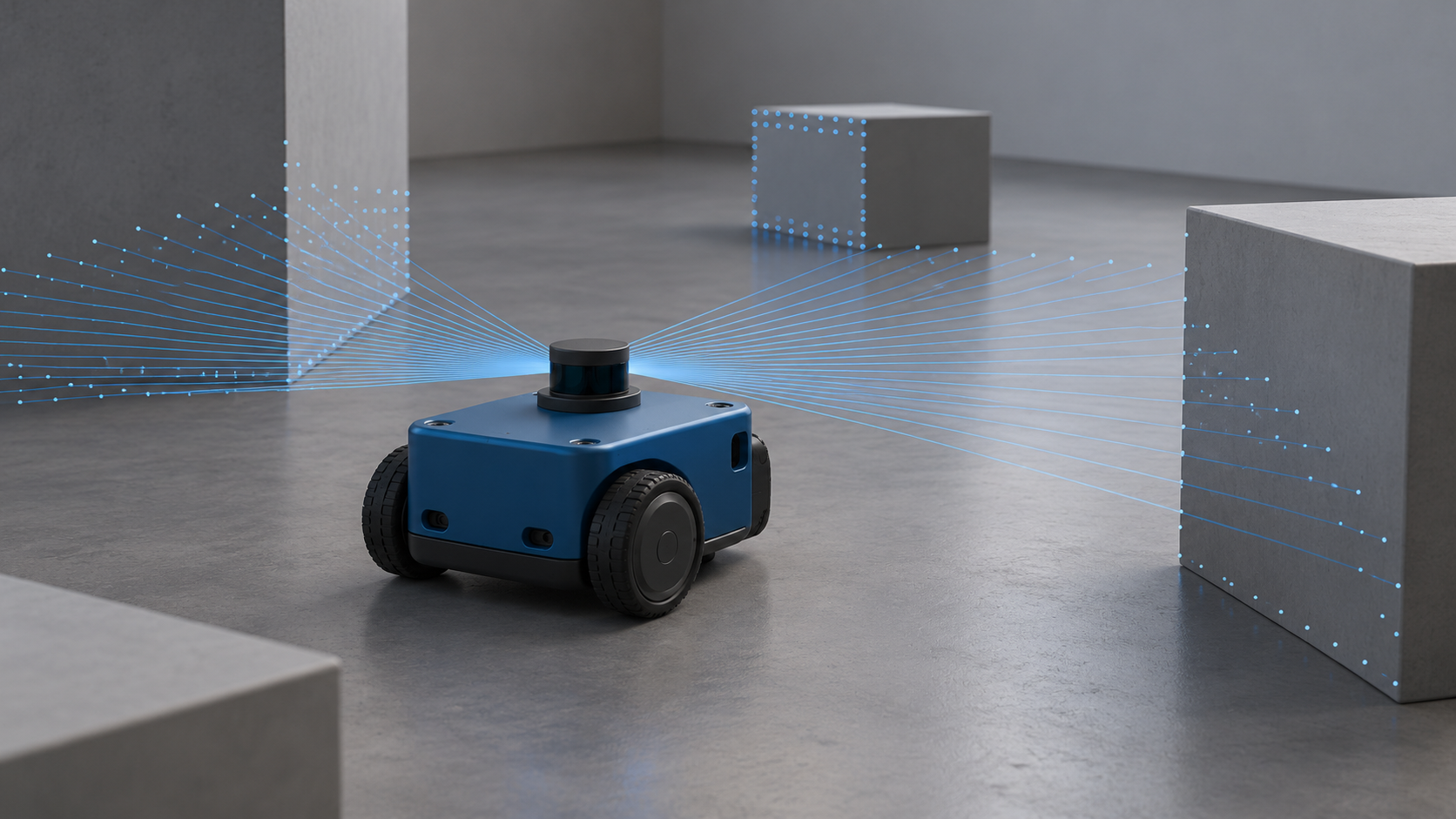
Let's talk about perception cameras, LiDAR, radar, the whole sensor buffet a real autonomous system uses to understand what's around it. And let's talk about the most underrated villain move in robotics: it's not blinding a robot that gets you, it's lying to it.
A robot with no data at least knows it's blind. It can stop, wait, ask for help. A robot fed convincingly wrong data thinks it knows exactly what's happening and confidently walks into a wall, a person, or a canal. An agent acting on a false but coherent picture of reality is far scarier than one that simply admits it can't see.
Los Santos is a masterclass in exactly this failure mode. Cops "lose" you not because their sensors go dark, but because your signal drops out of a search radius and their model of your location quietly goes stale; they're now acting on an outdated belief. Fog, night driving, and glare all mess with how NPCs "see" the road, the digital equivalent of a camera getting sun-blinded at the worst possible moment. And anyone who's driven through a firefight with muzzle flashes strobing across the screen has experienced, first-hand, what happens when a perception system gets more noise than signal.
This is why real robots don't trust one sensor. They fuse camera, LiDAR, and radar together, so if one gets fooled, the others can outvote it. It's the robotics version of not believing a rumor. Los Santos, tragically, has no radar to save it from its own fog.
4. Google Maps Can't Save You From Bad Localization
Here's a fun distinction, robotics people care about way more than normal people do: knowing where you're going is not the same as knowing where you are. GTA's minimap will cheerfully draw you a perfect route to your destination while you are, functionally, driving through a wall, because the map is only ever as good as the system's confidence in your actual position.
This is localization, and its fancier cousin, SLAM Simultaneous Localization and Mapping which is the process a robot uses to figure out "where am I on this map" while also updating the map itself in real time. Real robots do this by matching sensor data against known landmarks and correcting for drift. GTA does it by having your blue dot politely ignore the fact that you just launched off a ramp into a swimming pool.
Ever had the minimap arrow spin wildly during a police chase, or the GPS route recalculate five times because you clipped a fire hydrant? That's a localization estimate losing confidence in real time the system's internal "where am I" belief getting knocked out of sync with reality, then scrambling to re-anchor itself. It's the exact failure mode that makes real-world SLAM hard: sensors drift, wheels slip, GPS lags, and suddenly the dot on the map is standing in a lake that, as far as the map is concerned, doesn't exist.
The takeaway, both for delivery robots and for anyone escaping a five-star wanted level, is the same: a beautiful route means nothing if your starting point is wrong.
5. You Were Never Just Playing a Game.
So here's the reveal, and it was hiding in plain sight the whole time: every red light an NPC almost-but-not-quite ran, every pedestrian who flinched out of your bumper's way, every cop car computing an intercept angle, every foggy night where the game quietly nudged its own perception, all of it was robotics theory.
The city was never just a backdrop for your story. It was a large-scale, real-time demonstration of multi-agent coordination, reactive path planning, imperfect perception under adversarial conditions, and continuous localization disguised as a game so thoroughly that most of us never noticed we were watching robotics principles work under maximum stress.