Engineering students spend years learning how things work. But when they step into the industry, they're often expected to know how to make those things work.
That gap between understanding a concept and actually applying it is where most engineering education quietly falls short. Students can ace an exam on control systems and still freeze the first time they're handed a motor driver and asked to make something move. They can explain an algorithm on paper and struggle to debug it when it's running on real hardware, in real time, with real consequences.
What if education could bring students closer to the way engineering actually happens in industry not as an afterthought, not as a single elective, but as the core idea a company is built around?
Six years ago, that question became My Equation.
The Gap We Wanted to Bridge
The problem was never that engineering education lacked information. If anything, there's more information available today than ever before video lectures, open-source code, simulation tools, research papers, all one search away. The problem was distance. Distance between what's taught and what's practiced. Distance between the classroom and the industry floor.
That distance shows up in familiar ways:
- Classroom learning, instead of real-world application
- Theory, instead of hands-on implementation
- Learning about tools, instead of actually using them
None of these are wrong on their own. Theory matters. Exams have their place. But when they become the entire experience of learning engineering, students graduate with knowledge that hasn't been tested against reality. My Equation didn't set out to replace classrooms it set out to build the bridge that was missing.
Starting Small: Learning Beyond the Classroom
Every bridge needs a foundation, and ours started with making industry-oriented learning accessible to students wherever they were no matter which city, which college, or which lab they had access to.
That's how the first chapter of My Equation took shape: online industrial training programs designed around what the industry actually uses, not just what textbooks cover.
Programs like RoboAI, E-Drive, and training built around ROS 2 gave students a first real look at how robotics and automation work outside a lecture hall. These, Nano Degrees and structured industrial training modules let students go deeper building a working understanding of tools, workflows, and systems that mirrored what they'd eventually encounter on the job.
The goal in this phase was simple: take the walls off learning. A student didn't need to be in a particular city or enrolled in a particular institute to start closing the gap between classroom and industry. All they needed was a screen and the willingness to build.
Idea had become online learning. But that was only the first step.
But Engineering Can't Stay on a Screen
There was always a limitation to learning engineering online.
You can watch a robot move. You can simulate a robot. You can write code for a robot, watch it execute in a virtual environment, and feel like you understand it completely.
But eventually, you need to stand in front of the machine. You need to feel a motor stall because the current draw was wrong. You need to watch a sensor return noisy data and figure out, in real time, whether it's a wiring issue, a calibration issue, or a code issue. You need to work with people standing next to you, sharing the same failing prototype, solving the same stubborn problem at midnight before a demo. Simulation can teach logic. Only hardware can teach the reality.
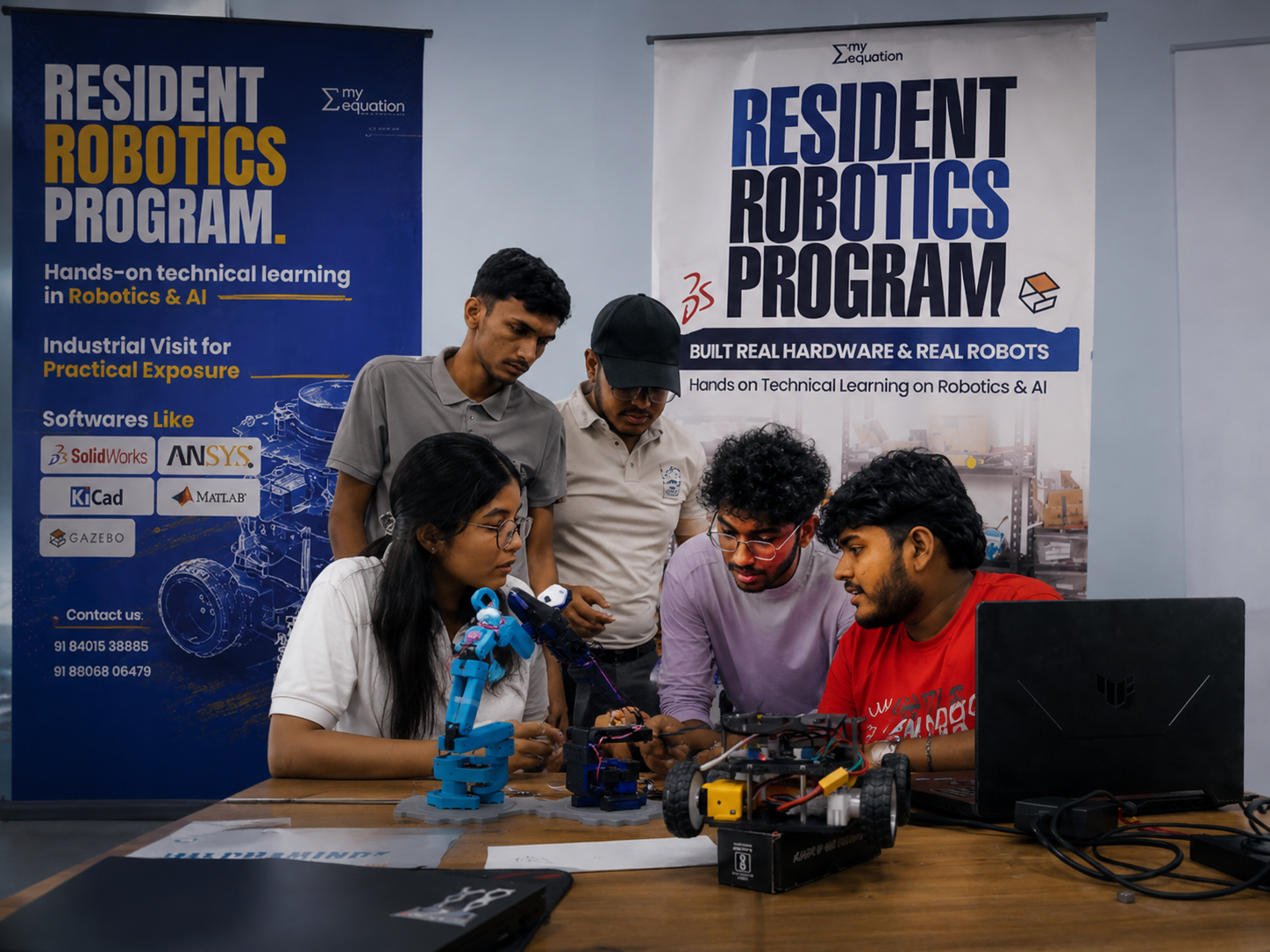
That's where the next chapter of My Equation began: the Resident Robotics Program (RRP).
From Learning About Robotics to Building Robots
RRP isn't a program defined by its duration or its module count. It's better understood as the natural evolution of everything My Equation had been building toward from the start.
Online, students learn. Offline, they build.
At RRP, that shift becomes physical. Students go from watching a TurtleBot navigate a simulated map to building and debugging one in front of them. From reading about quadruped locomotion to working alongside a quadruped robot that doesn't care how well the theory reads on paper it only responds to what's actually implemented correctly. From coding a robotic arm in a virtual sandbox to wiring, assembling, and calibrating a robotic arm that has to work, not just simulate working.
The scope of what students engage with at RRP reflects the full stack of real robotics work:
- Real hardware robots like TurtleBot, Spot-style quadrupeds, campus delivery bots, and robotic arms
- Mechanical design and assembly, where tolerances and torque matter as much as code
- Electronics, wiring, and the unglamorous debugging that comes with both
- ROS 2 as the backbone connecting perception, planning, and control
- Computer vision, taking models out of notebooks and into live camera feeds
- Simulation, now used the way industry uses it as a testing ground before hardware, not a substitute for it
- Mentorship from people who've solved these exact problems before
- Collaboration, because no meaningful robotics project is built by one person alone
We didn't just move our courses offline. We moved learning closer to reality.
That's the sentence that captures six years of work more honestly than any list of achievements could. My Equation didn't pivot away from what it started with it followed the same idea to its logical, physical conclusion. A student who once learned ROS 2 through a screen can now debug it on a robot they helped assemble. A student who once simulated a robotic arm can now watch it move because of code they wrote and wiring they checked twice.
The People Behind the Equation
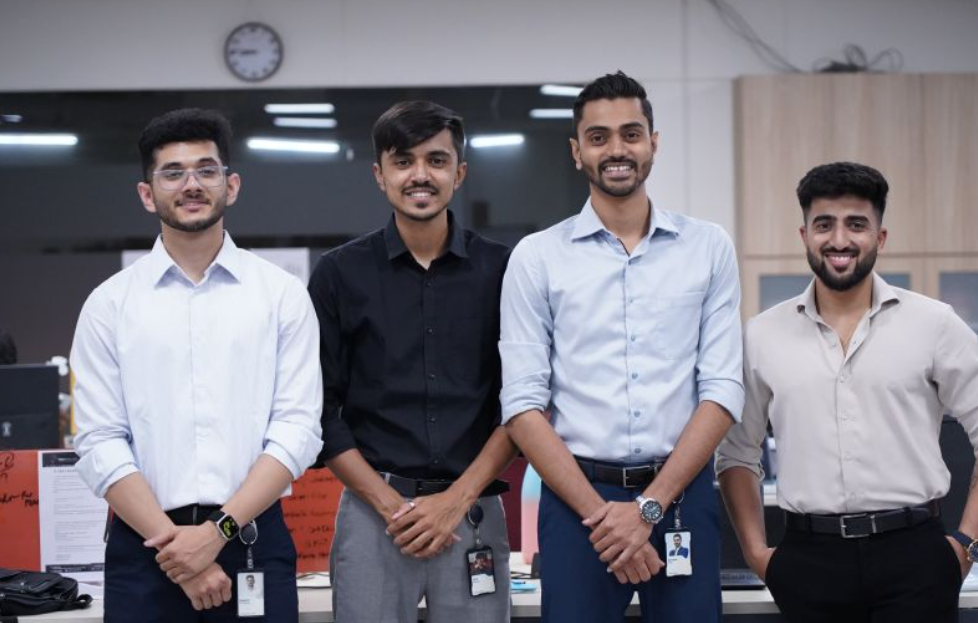
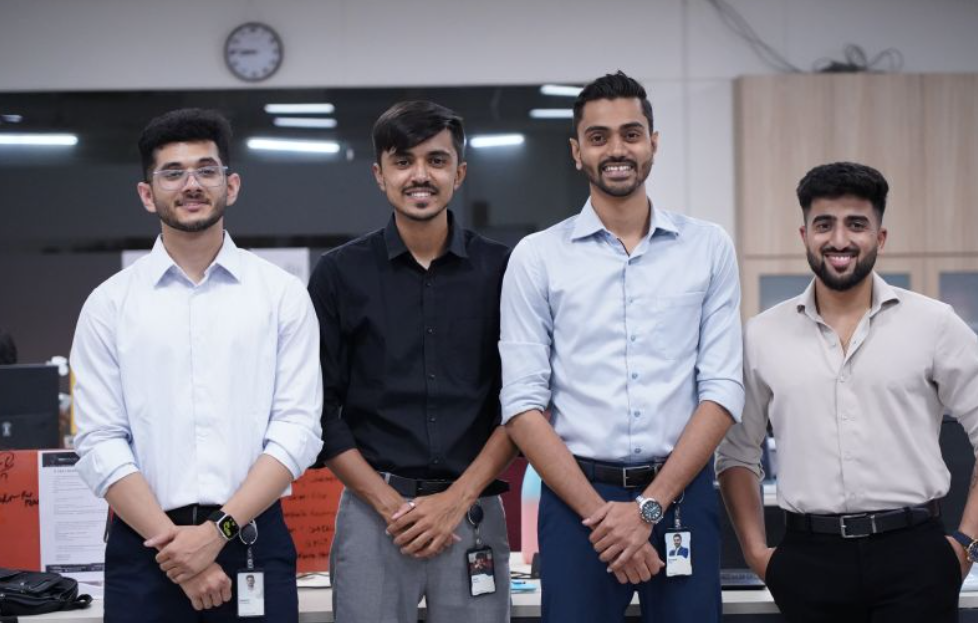
None of this happens because of one person or one idea alone. It happens because different people, pulling in the same direction with different strengths, decided to build something together.
The Vision Mr. Ratik Gupta, Founder, is the reason My Equation exists at all the person who looked at the gap between classroom and industry and decided it was worth building a company to close it.
The Operations Mr. Kaustav Mohanty, Co-founder & COO, is the reason ideas turn into programs that actually run, on time, at scale, without losing sight of the students they're built for.
The Creative Mr. Tirth Kalaria, Creatives Head, shapes how My Equation is seen and understood turning technical work into something students actually want to engage with.
The Growth Mr. Gunesh Patil, Sales & Marketing Head, makes sure that the students who need this bridge the most actually find their way to it.
The Technology Mr. Ajay Vaishnav, Technical Head, is the one ensuring that everything students touch online or in the lab is technically sound, current, and genuinely worth their time.
Different roles. Different responsibilities. One equation.
What Comes Next
Six years ago, this started with a question about the distance between what students learn and what industry expects. That question hasn't been fully answered yet and it probably never will be completely, because industry keeps moving, and so does the technology students need to master.
But the direction is clear. From an idea, to online learning, to a community of learners, to a growing robotics ecosystem, to students standing in front of real machines they built with their own hands My Equation has spent six years moving learning closer to reality, one step at a time.
The next chapter is already being built.