In an era dominated by MOOCs, YouTube tutorials, and AI-powered learning platforms, Robotics education has never been more accessible. Aspiring engineers can learn Python, study ROS2 documentation, or simulate robot behaviors from anywhere with an internet connection. Yet, many industry leaders and educators still emphasize the irreplaceable value of offline robotics training. Why does hands-on, in-person learning remain essential even as digital tools advance? This article explores the unique advantages of offline programs and why they continue to play a critical role in developing skilled engineers.
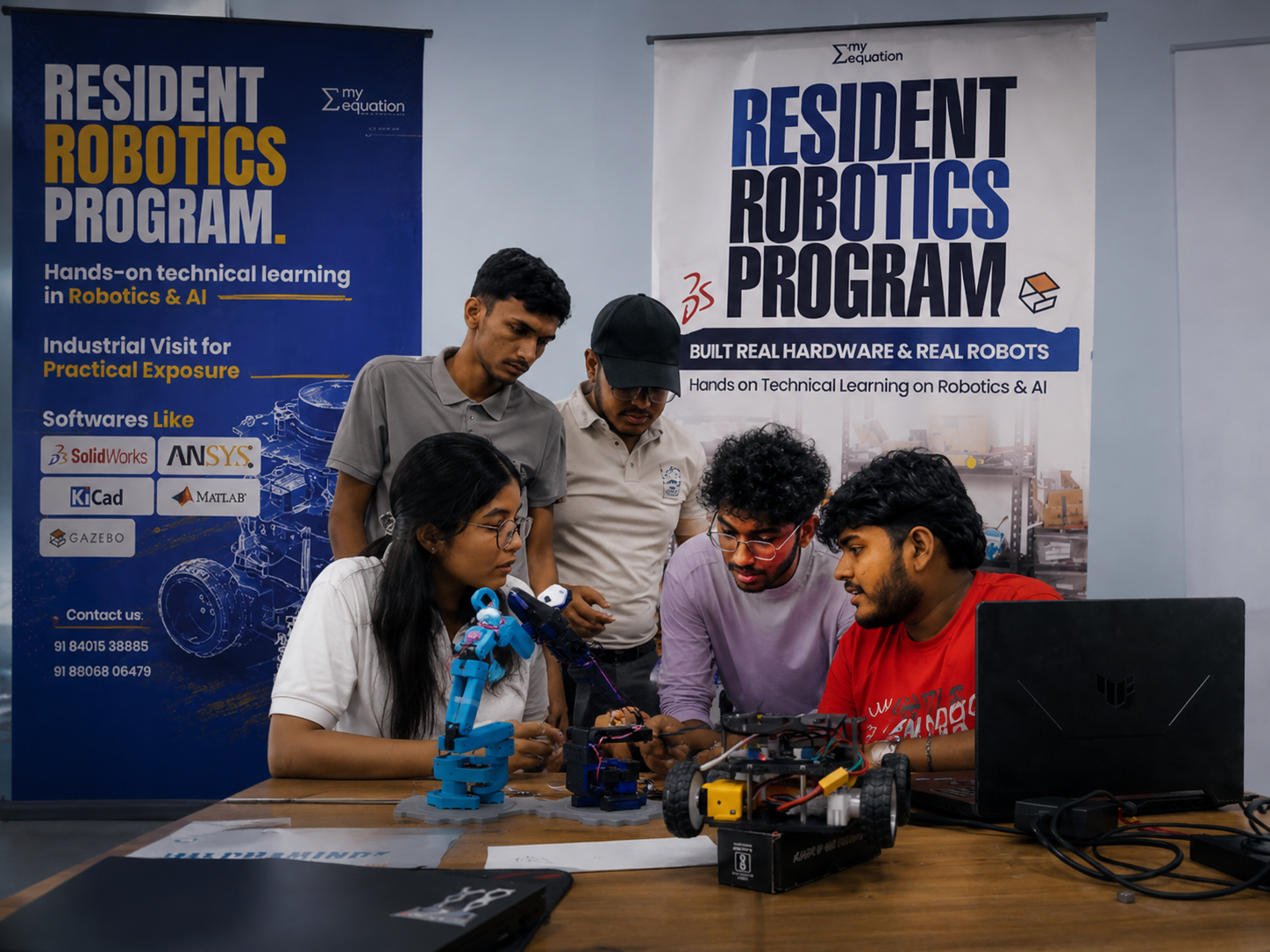
After 6 years of bridging the gap between college classrooms and what the industry actually expects, that's the exact conclusion we've arrived at too. My Equation has spent those years building a community of 44,000+ learners now we're moving further into the offline approach, because that's where the gap between "I understand this" and "I can build this" actually closes. That's the thinking behind the Resident Robotics Program.
The Actual Software Stack We Teach
A good robotics program doesn't stop at "here's a motor, here's some code.", the program walks you through the full professional toolchain.
Mechanical Design: Before a single motor gets bolted on, you're modeling. chassis, gears, and mounts in SolidWorks. You learn structural analysis and design for real payloads, then move straight into 3D printing and assembly so the CAD file you built is the actual part you're now holding.
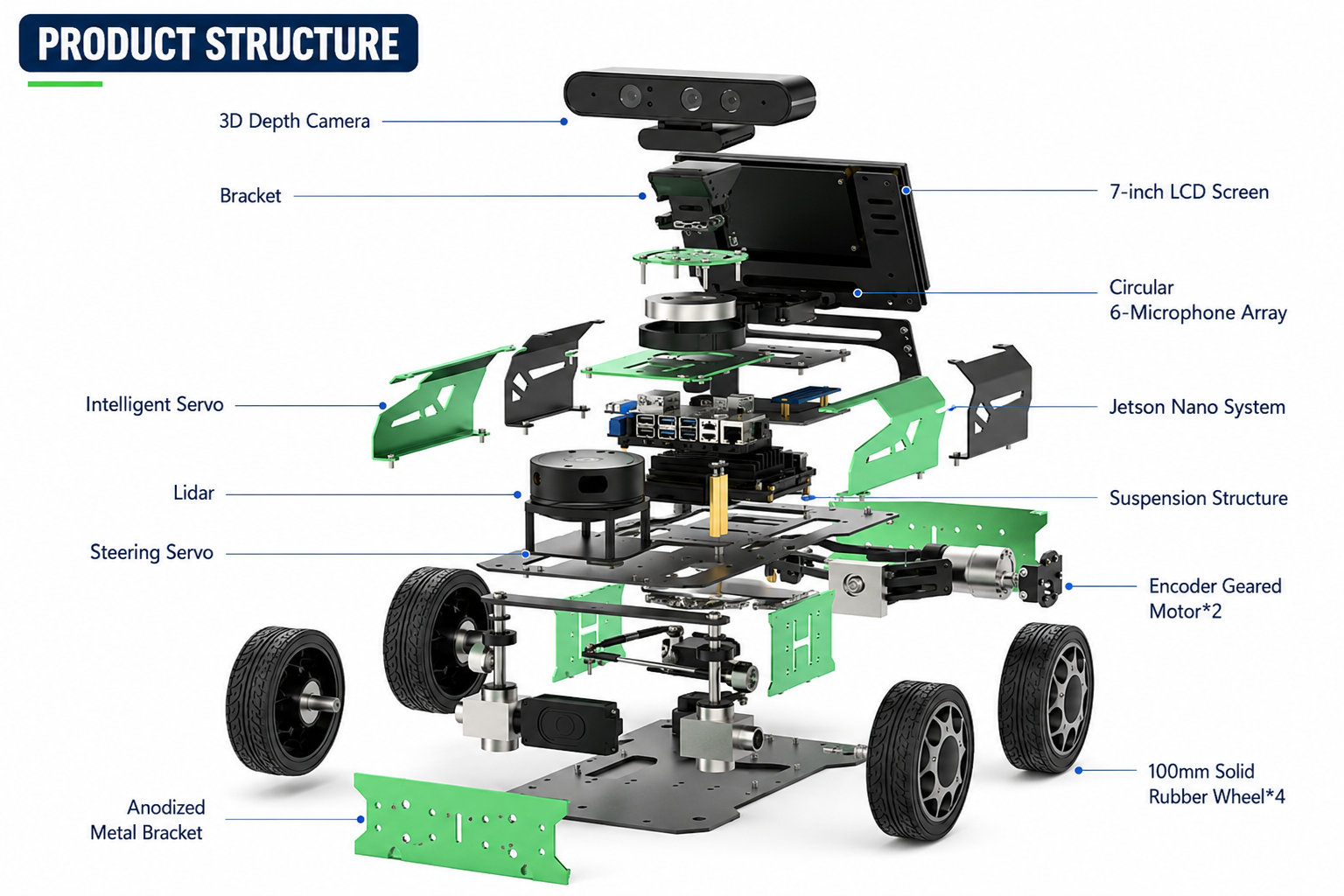
Electronics & Embedded Systems: This is the framework that ties your entire robot together. PCB design in KiCad alongside sensor integration and low-level programming, with ROS2 as the backbone connecting every subsystem. You'll write and deploy your own ROS2 nodes.
Perception and Autonomy: Perception is where robots stop being blind. Computer vision with OpenCV for object detection and tracking, paired with RViz for visualizing sensor data, robot state, and LiDAR-based maps in real time. You'll implement SLAM and see, literally on screen, what your robot thinks the world looks like then correct it when reality disagrees.
Simulation to Real-World Deployment : Gazebo is where you prototype safely before risking real hardware testing control logic, sensor placement, and navigation stacks in a physics-accurate environment.Gazebo is a starting point, not the finish line. Every project moves from Gazebo simulation into Sim2Real deployment on an actual robot, which is where the real learning happens.
Control Systems Implementing PID, LQR, or model predictive control on physical hardware, and tuning parameters while watching the robot actually respond to something no simulation captures with the same honesty.
By building multiple robots across these tools balancing bots, robotic arms, quadrupeds students leave with end-to-end experience across SolidWorks, ROS2, OpenCV, RViz, and Gazebo that employers actually screen for.
Don't Try This at Home
Let's be honest. Most of us have run at least one dangerous experiment in our own room. High-current motors jumper-wired straight to a bench supply. LiPo batteries charged unattended on a bedsheet because the balance charger felt like a suggestion, not a rule. Spinning mechanisms tested two inches from your face because "it'll be fine.x" Every engineering student has had this exact phase, and most of us are lucky it ended in a funny story instead of a burn ward.
Offline programs are where that phase gets professionally corrected. You're in a controlled lab with actual safety protocols and mentors standing over your shoulder who have personally seen every single way a robotics project can go wrong. That last part matters more than it sounds: a mentor who's watched a badly fused board let the smoke out doesn't just tell you "be careful," they show you exactly where the current was supposed to stop and didn't.
Solo Suffering vs Squad Debugging
Online group projects have a well-documented failure mode: four people, one shared Google Doc, and a WhatsApp group where someone sends "guys can we meet" every three days without anyone actually meeting. Research on engineering students taking hands-on courses online has specifically flagged peer collaboration as one of the hardest things to replicate remotely which tracks, because "collaboration" over a laggy call is not the same as four people staring at the same malfunctioning robot at 2 AM.
One of the biggest advantages of offline training is the community. Online, you’re often alone with your bugs at 2 AM, refreshing Stack Overflow. In a physical lab:
- You can immediately ask someone, “Bro, why is my LiDAR giving garbage data?”
- Collaborate on integrating mechanical, electronics, and software subsystems
- Learn from others’ mistakes in real time
This mirrors actual industry work far better than isolated online learning.
What Offline Programs Prepare You For?
Real robotics isn't about finishing a course. It's about knowing what to do when the robot refuses to cooperate. That's the bar My Equation builds the Resident Robotics Program around. reframe it cuz i have already used it somewhere so it looks repetitive.
By the end of it, you're not just someone who's "learned robotics." You're someone who can take a project from a blank SolidWorks sketch to a robot moving under its own power, and who's touched every stage in between: designing the mechanical body, wiring and programming the electronics, giving the robot eyes through computer vision, validating behavior in simulation, and then debugging it for real when simulation.
So… Is It Worth Learning Robotics in 2026?
Absolutely yes, but not the way most people think.
Online resources in 2026 are genuinely excellent for theory. A 2024 meta-analysis on virtual labs found they meaningfully improve engagement and retention, and nobody's arguing you should skip YouTube tutorials or simulators. Use them. They're fast, they're free, and they'll teach you what a GPIO pin, a PID loop, or a ROS2 topic actually is.
But "knowing what it is" and "being the person a team trusts to debug it when it breaks” are two different resumes. The second one only gets built through direct, occasionally chaotic contact with real hardware burnt fingers, dead breadboards, teammates yelling the fix from across the room, and the very specific joy of watching something you built actually move because you told it to.
If everything above sounded less like an article and more like a checklist you'd rather tick off in person than in a browser tab that's the Resident Robotics Program (RRP). Just don't confuse "I watched the tutorial" with "I can build the thing." One of those gets you a certificate. The other gets you a job.